
Carlo Simmons · 16 September 2026
The Role of Secure Data Handling in Contemporary Web Applications
Secure data handling forms the backbone of web applications that process user information daily, and developers integrate encryption protocols along with access restrictions to protect sensitive details during transmission and storage. Organizations rely on standards such as TLS 1.3 for securing communications while they apply AES-256 algorithms to safeguard stored records, and these measures reduce exposure when attackers attempt interception or unauthorized retrieval.
Core Techniques in Data Protection
Contemporary web applications implement input validation routines that sanitize user submissions before database queries execute, and this approach blocks common exploits like SQL injection that researchers documented in multiple incident reports over recent years. Token-based authentication systems replace traditional password mechanisms in many platforms, which allows session management without exposing credentials repeatedly across network requests.
Access control lists define permissions at granular levels so that applications grant only necessary privileges to each user role, and audit logs capture every data access event for later review by security teams. Data minimization principles guide developers to collect only essential fields during registration flows, which limits the volume of information available in any single breach scenario.
Regulatory Frameworks Shaping Practices
Government agencies across regions enforce rules that require organizations to report incidents within specific timeframes, and the Australian Cyber Security Centre provides guidelines that align with similar directives from Canadian authorities on protecting personal data in digital services. In September 2026 updated compliance timelines will take effect for certain cross-border data transfer protocols, prompting web application teams to revise their encryption key rotation schedules accordingly.
Industry reports from sources like the National Institute of Standards and Technology detail how organizations that adopt zero-trust architectures experience fewer successful intrusions compared with perimeter-only defenses, and these findings encourage broader adoption across sectors handling financial or health records.
Emerging Threats and Mitigation Strategies
Supply chain attacks targeting third-party libraries have increased in frequency, which forces development teams to verify package integrity through checksum validation before integration into production environments. Observers note that containerized deployments benefit from runtime security tools that monitor memory access patterns, and these systems flag anomalous behavior before data exfiltration occurs.
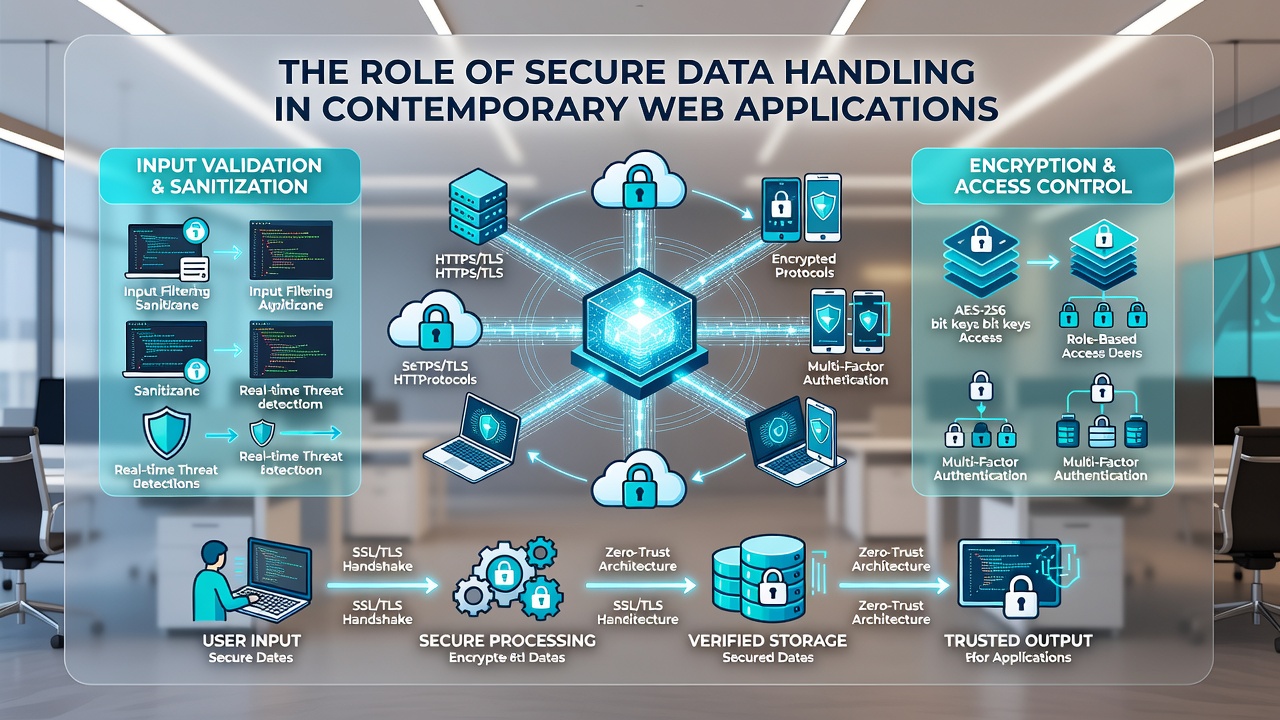
Multi-factor authentication combined with behavioral analytics helps distinguish legitimate sessions from automated scripts, while rate-limiting mechanisms prevent brute-force attempts on login endpoints. Encryption key management services offered by major cloud providers rotate credentials automatically, and this automation reduces human error in long-term maintenance tasks.
Implementation Across Application Layers
Front-end code employs content security policies that restrict script sources and block inline execution where possible, and these configurations limit the impact of cross-site scripting attempts. Backend services isolate database connections within virtual private networks, and query parameterization ensures that user input never executes directly as code.
Backup procedures include encrypted snapshots stored across geographically distributed locations, and recovery testing occurs at regular intervals to verify that restoration processes maintain data confidentiality. Developers document data flow diagrams during the design phase, which helps identify potential leakage points before deployment reaches production.
Conclusion
Secure data handling continues to evolve alongside web application architectures, and organizations that integrate these practices across development lifecycles maintain stronger positions against persistent threats. Standards bodies and regulatory entities provide frameworks that guide consistent implementation, while technical controls address both current vulnerabilities and anticipated challenges in data protection.